


Last updated: August 11, 2026 · Reading time: ± 7 minutes
Anyone shopping for a motorcycle LED turn signal quickly drowns in the options: dozens of shapes, sizes, colours and prices. But what photos and product descriptions never show you is how well a turn signal actually performs. And that matters, because a turn signal is first and foremost a safety device: other road users need to see your indicator clearly, even in bright sunlight. That's why we put five popular LED replacement turn signals through a hands-on test and measured their light output. In this article you'll read how we tested, what the results are, which accessories you need to actually install one, and what to look out for before you buy.
| Goal | Recommendation |
|---|---|
| Maximum visibility / daytime safety | Aharon Motolumino V2, highest measured output, 1.60 kLux |
| Road-legal aftermarket budget pick | Test version 3, 0.97 kLux, ECE-marked |
| Avoid | Test version 1, no ECE approval; test version 2, 8x less light output than the Motolumino despite ECE marking |
1. Why test motorcycle LED turn signal brightness?
There are thousands of LED turn signals for motorcycles for sale online, from budget models on marketplaces like AliExpress and Temu to premium branded products. Based on photos and spec sheets, many products look near identical, and manufacturer brightness claims are rarely independently verifiable. So we set out to objectively measure how the most popular models perform on the single most important criterion for a turn signal: visibility.
2. The test field: 5 motorcycle LED turn signal sets compared
Since it's impossible to test every option out there, we made a deliberate selection of five sets. Three of them we ordered ourselves via Amazon, picking bestsellers that also had a decent average review score, in other words, the models a typical buyer is most likely to end up with. One set was provided as a sample by a manufacturer, and the fifth is our own Aharon Motolumino V2. The four third-party models are referred to in this article as "test version 1 to 4".
Transparency: the Motolumino V2 is our own product, and one of the tested sets was supplied free of charge as a manufacturer sample. That's exactly why we chose a measurable, reproducible test method that anyone can verify, including video footage of the measurements.
3. First impressions: housing, lens and internals
One thing stands out immediately: the housing and lens of the tested aftermarket turn signals are more or less identical. They presumably come from the same (or similar) factories. There is some variation in the mounting rubber. The biggest difference is in the clearly visible internals: the printed circuit board (PCB) with the LEDs differs noticeably between models in both layout and finish. As we'll see further on, that affects not just the looks, but the performance too.
4. Sequential turn signals: what are they, and are they legal?
Without exception, all tested turn signals feature a sequential effect (also known as flowing or running indicators): the LEDs light up progressively from the inside outwards, simulating a moving strip of light. A creative application that Audi in particular is known for.
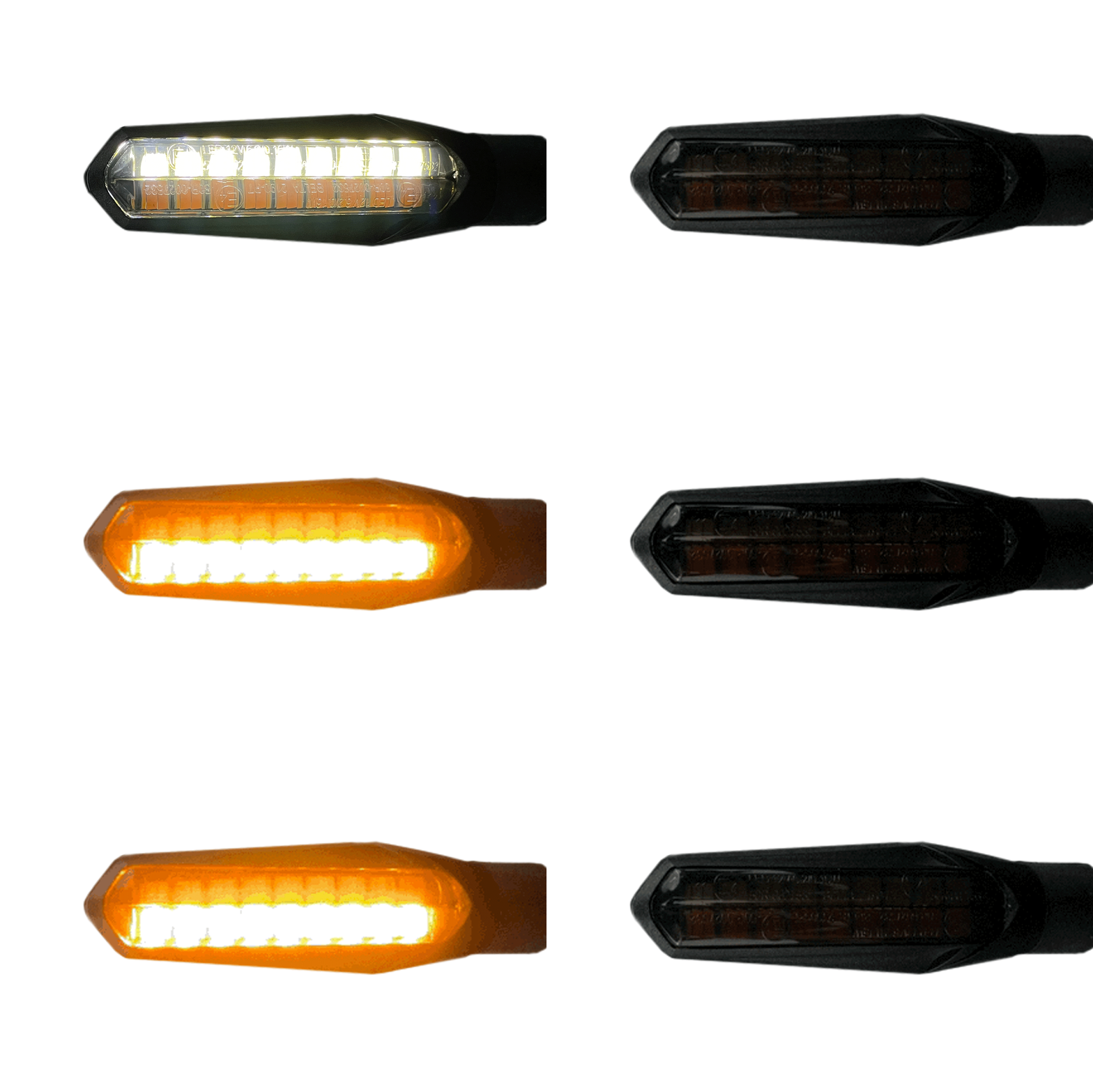
Good to know: sequential turn signals are legal in Europe, but only under certain conditions. The light must travel from the inside outwards, and the full sequence must be completed within the flash cycle. As we'll see in the results, one of the tested models fails on exactly that point.
5. ECE marking on motorcycle turn signals: what the law says
With one notable exception, the tested lamps carry an ECE marking: test version 1 has no ECE approval at all, which means it is not road legal in Europe to begin with. Telling detail: this model isn't available on Amazon Germany, which enforces approval requirements far more strictly than other marketplaces. For turn signals on motorcycles, European requirements apply on two levels:
Light intensity (component): the photometric requirements for turn signals on L-category vehicles (motorcycles) are laid down in UN/ECE Regulation No. 148 (formerly Regulation No. 50). It specifies minimum luminous intensities per indicator category, measured in candela along the axis of reference.
Flash frequency (installation): UN/ECE Regulation No. 53 requires a turn signal to flash 90 ± 30 times per minute, with the light appearing within one second of operating the switch.
6. The test setup
To compare the five turn signals fairly, we measured them one by one with a lux meter, under identical conditions:
- Connected to the same power source (identical voltage for every model)
- Always with the same distance between the sensor and the turn signal
- Using a matte black cardboard tube around the sensor, to eliminate stray light and ambient light
The full test was recorded on video:
7. Results: maximum light output in kLux
The chart below shows the maximum measured light output per model:

| Model | Max. light output (kLux) | ECE approval | Where to buy |
|---|---|---|---|
| Aharon Motolumino V2 | 1.60 | Yes | Our webshop |
| Test version 1 | 1.18 | No | Amazon FR · Amazon IT |
| Test version 2 | 0.18 | Yes | Manufacturer sample (not sold via Amazon) |
| Test version 3 | 0.97 | Yes | Amazon DE · Amazon FR · Amazon IT |
| Test version 4 | 0.74 | Yes | Amazon DE · Amazon FR · Amazon IT |
Disclosure: the Amazon links above are affiliate links. If you buy through them, we may earn a small commission at no extra cost to you.
8. What stands out? Our analysis
The Motolumino delivers the strongest light output, despite its tinted lens. The fact that the brightest lamp is the one model with a tinted (smoke) lens shows just how large the differences in LED quality and driver electronics really are.
Test versions 1 and 3 perform reasonably well, but look less refined. Both models achieve decent light output. However, on both, a white PCB is visible through the lens, and the LED chips themselves are clearly visible too. On test version 1 in particular, the yellow phosphor coating of the LEDs is very prominent, not a pretty sight on an otherwise cleanly finished motorcycle.
Test version 2 falls dramatically short. At just 0.18 kLux, the manufacturer sample measures barely more than a tenth of the Motolumino's output (1.60 kLux) and far below every other model in the test. Despite carrying an ECE marking, this is exactly the kind of result that raises the "reasonable doubt" we mentioned earlier about whether the minimum luminous intensity is genuinely met.
Test versions 2 and 4 also give away their budget origins. On both models, the LED chips and PCB are clearly visible through the lens, giving them a distinctly cheap impression, similar to what we saw on test versions 1 and 3. The fit and finish of the PCB housing and the mounting rubber is mediocre on both, though still acceptable overall.
9. What you need to install a motorcycle LED turn signal
Brightness is only half the story, a turn signal also has to physically fit and wire in correctly. Most bikes were never designed for aftermarket LED turn signals, so three things typically stand between the light in the box and a finished installation: a mounting plate or adapter bracket for your specific bike, a wiring adapter cable to match the connector on your loom, and a load-matched relay to prevent hyperflashing (rapid blinking) or CANbus error messages once the old, higher-resistance bulb is replaced with a low-power LED.
If you already own a set and only need a replacement or spare connector, the individual parts are also sold separately. Based on our own sales data, these are the most-installed parts:
10. Which turn signal kit fits your motorcycle?
The Motolumino V2 that won this test is available as a complete, model-specific kit for a growing list of motorcycles. These are our most popular fitments:
| Yamaha MT-07 (2014–2020) | View kit → |
| Yamaha MT-09 (2017–2020) | View kit → |
| Kawasaki Z650 (2017–2019) | View kit → |
| Kawasaki Z900 (2017–2019) | View kit → |
| Triumph Tiger 1050 (2007–2013) | View kit → |
| Honda CBR600RR (2007–2016) | View kit → |
Don't see your bike listed? Select your motorcycle on the Motolumino V2 product page, new fitments are added regularly.
11. Conclusion: which motorcycle LED turn signal should you buy?
This test was carried out some time ago, and unfortunately the four third-party turn signals are currently (temporarily) unavailable. That means we can't give you up-to-date pricing to weigh against the results, but the light output figures themselves remain just as relevant, since they say nothing about price and everything about how these products actually perform.
And on that measure, the result is unambiguous. The Aharon Motolumino V2 measured 1.60 kLux, well ahead of the best aftermarket model (test version 1, 1.18 kLux) and more than eight times the output of the weakest one (test version 2, 0.18 kLux). In a turn signal, light output isn't a nice-to-have: it's what determines whether another driver notices your indicator in time, especially in bright sunlight. On that basis, the Motolumino is the clear winner of this test.
Beyond the numbers, the Motolumino also has a more distinctive design. That's admittedly a matter of taste, but its sharper silhouette, the noticeably better fit and finish of the materials, and the tinted lens all set it visibly apart from the aftermarket alternatives, which, as we saw in section 3, are largely built on the same generic housing and lens.
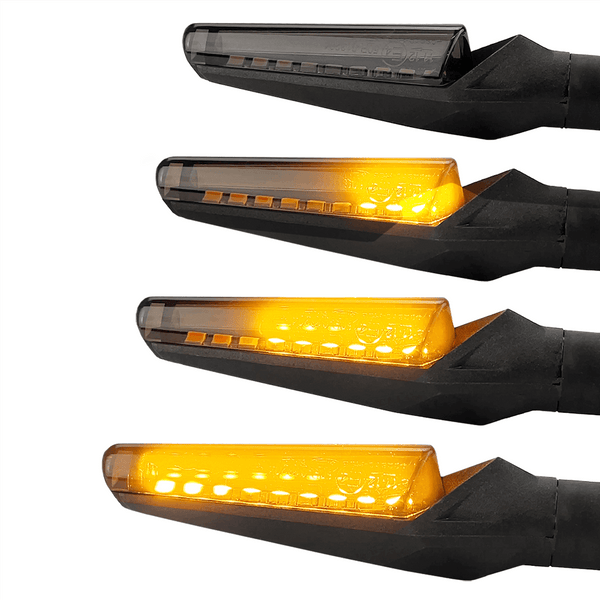
Side profile
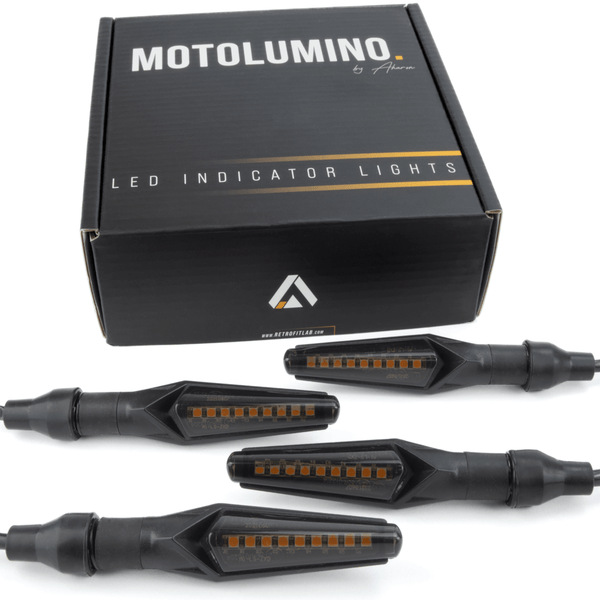
Installed
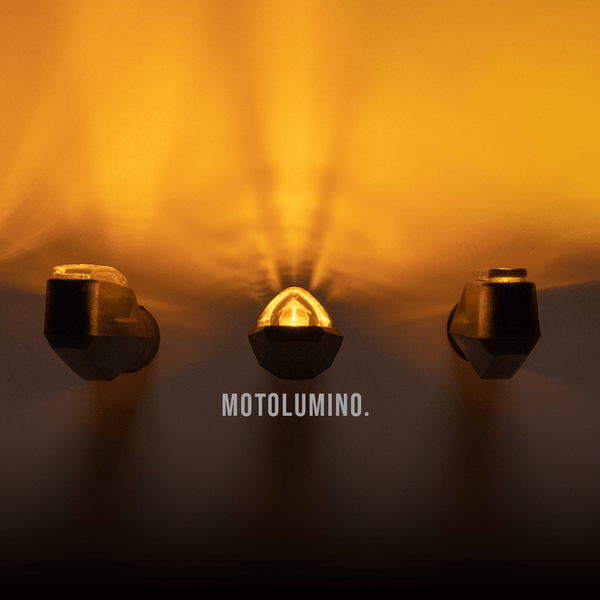
Lit, visibility from the side
If you do decide to shop for a budget alternative, use this test as a checklist: verify the ECE marking is genuine, check that the sequential effect completes within the flash cycle, and where possible, look for independent brightness measurements rather than relying on marketing photos alone.
12. Frequently asked questions
Are LED turn signals legal on a motorcycle? +
Yes, provided they carry a valid ECE approval (E-mark) and are mounted correctly. Also pay attention to the flash frequency: it must be between 60 and 120 flashes per minute. When switching from incandescent bulbs to LED, an LED flasher relay or load resistor is often required to prevent hyperflashing.
Are sequential (flowing) turn signals legal? +
Yes, sequential turn signals are permitted in Europe under certain conditions. The light must travel from the inside outwards, and the full sequence must be completed within the flash cycle.
How bright does a motorcycle turn signal need to be? +
The minimum luminous intensity is laid down in UN/ECE Regulation No. 148 (formerly No. 50) and differs per indicator category. The value is measured in candela along the lamp's axis of reference.
Does an ECE marking guarantee that a turn signal is good? +
An ECE marking should mean the product has been approved under the European regulations. In practice, however, we see large differences in light output among cheap imported products, so doubt about the marking is sometimes justified. That's why it pays to buy from a reputable supplier.
Do motorcycle LED turn signal kits come with the mounting hardware and relay? +
It depends on the kit. Model-specific kits (like the ones listed above) include the correct mounting plate, adapter cable and relay for that exact motorcycle. Universal kits typically don't, you'll need to check your bike's connector type and add a relay separately to avoid hyperflashing.
Why would an ECE-approved turn signal still be dim? +
ECE approval is meant to guarantee a minimum light output, but our test found an ECE-marked model measuring only 0.18 kLux, roughly a tenth of the brightest model tested. Independent measurement is currently the only way to confirm a product actually performs at the level its marking implies.
What's the difference between the Motolumino V1 and V2? +
The Motolumino V2 tested in this article is our brightest turn signal, measured at 1.60 kLux. Our other model, the LED Sequential Turn Signal with position and brake light (4 pcs kit), wasn't the version measured in this test and isn't as bright, but it adds two functions the V2 doesn't have: a white position light on the front turn signals and a red brake light function on the rear.
In short: pick the V2 for maximum daytime visibility, or the position/brake light kit if those extra functions matter more to you than outright brightness.
Questions about this test or about installing LED turn signals? [Contact us / link to product page].